IoT is past the hype now. The real question isn't whether the tech works, it plainly does. It's whether it fits your business. A practical tour of what's genuinely delivering in 2026, and a straight answer on when it isn't worth it.
Rewind a few years and IoT was mostly a promise. In 2026, it's mostly a tool, and a proven one at that. So the interesting question has changed. It's not whether the technology works, it plainly does, but whether it fits your particular business.
Here's the thing: unlike most tech trends, the honest answer for IoT is "sometimes yes, sometimes no." IoT fits when physical things drive your operations and seeing their status live would change what you do. It doesn't fit when there's no physical layer to your business, or when you already have full, reliable visibility. Anyone telling you every business needs IoT isn't advising you. They're selling.
So instead of arguing about the technology, let's walk through the use cases genuinely delivering this year, and then I'll hand you a straight checklist for working out whether your business is one where IoT actually pays off.
None of these are experiments. They're proven, everyday applications, and businesses run them because the payback is obvious.
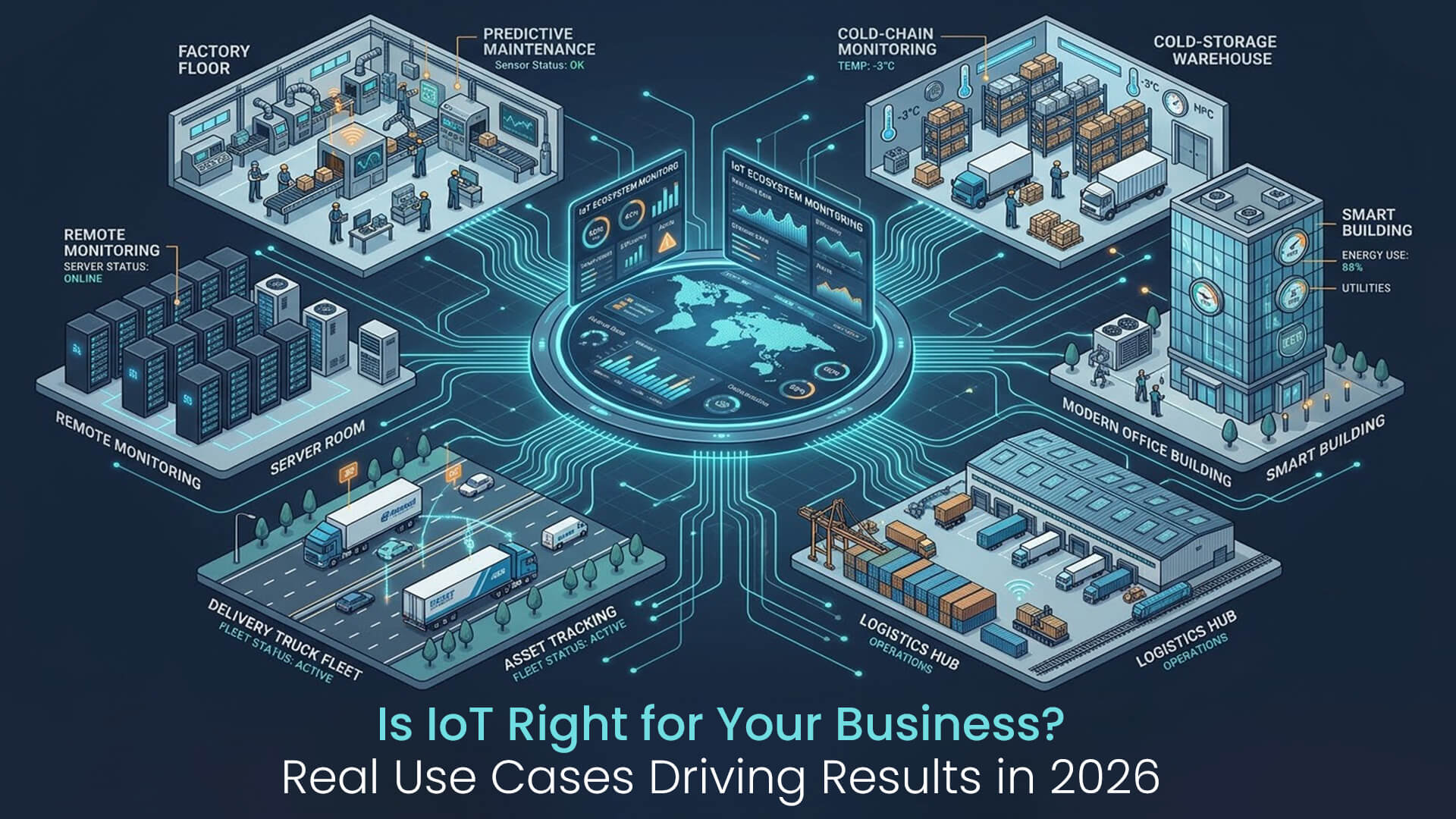
Predictive Maintenance — manufacturing. Sensors sit on the machinery and watch for the early tells, then flag them before anything breaks. Unplanned downtime is brutally expensive, and this is the most common IoT win by a mile.
Asset & Fleet Tracking — logistics. Put trackers on your vehicles, containers and high-value kit, and you know where everything is, live. Routes tighten up, fuel waste drops, deliveries get more reliable.
Cold Chain & Environment Monitoring — pharma / food. Sensors watch conditions round the clock and alert you the second something drifts out of range, before a batch spoils or you cross a compliance line.
Energy & Utility Optimisation — facilities. Metering and monitoring show you precisely where the energy and water go, and waste that was invisible is staring back at you.
Smart Building & Security — real estate. Connected access control, occupancy sensing, lighting and climate together turn a building into something that actually responds.
Remote Equipment Monitoring — field services. Devices report their own status and health non-stop, so you can diagnose from your desk and get ahead of problems with proactive service.

Illustrative snapshot of proven IoT use cases across industries — not a specific client dataset.
The more that left column sounds like you, the stronger your case. The more the right column fits, the more you should probably hold off.
| IoT Is Worth It When… | Hold Off When… |
|---|---|
| Physical assets or devices are central to your operations | Your work is purely digital, with no physical layer to monitor |
| Downtime, spoilage, or failures are costly | The odd bit of downtime has little real impact on you |
| You lack visibility into what's happening on the ground | You already have full, reliable, real-time visibility |
| Data is collected manually and inconsistently | Manual checks are rare, simple, and low-stakes |
| You manage many devices or sites, often remotely | Everything sits in one place and is easily checked in person |
| You want to shift from reacting to predicting | Reacting to issues as they arise works perfectly well for you |
| Energy, waste, or usage costs are significant | These costs are negligible in your business |
| You're ready to start with one focused pilot | You'd only ever do it as a huge, all-at-once project |
A good partner names the downsides out loud. Here are the three that actually matter, and how to keep them small.
At Swaran Soft, the first conversation is an honest fit check: which use case, what return, and whether IoT is even the right answer for you. And if IoT isn't right for your business? We'll tell you that too.
| Industry | Common Use Case | Typical Result | Where to Start |
|---|---|---|---|
| Manufacturing | Predictive maintenance | Less unplanned downtime, longer equipment life | One critical machine or line |
| Logistics & Transport | Fleet & asset tracking | Lower fuel waste, reliable deliveries | A single fleet or route |
| Pharma & Food | Cold-chain monitoring | Less spoilage, fewer compliance failures | One storage or transport link |
| Facilities & Real Estate | Energy & smart building | Lower utility bills, efficient spaces | One building or floor |
| Healthcare | Equipment & asset monitoring | Better uptime, faster response | Critical equipment first |
| Agriculture | Soil, crop & climate sensing | Better yields, less water and input waste | One field or greenhouse |
| Utilities | Grid & network monitoring | Faster fault detection, less loss | One segment of the network |
Rough benefits from the use cases IoT actually suits. Honest ranges, not sales numbers, and the specifics depend on your operation.
Weighing up whether IoT is worth the investment across the whole operation.
Pain: Struggles to tell the genuine, proven use cases from the hype, and isn't sure where the return would actually come from.
Outcome: A clear read on which use cases fit, ranked by payback, plus a focused pilot to prove it on real numbers.
Runs assets and equipment where downtime and inefficiency really hurt.
Pain: Reactive maintenance, hidden energy waste, and no early warning before something goes down.
Outcome: Predictive alerts, energy use you can finally see, and equipment serviced at the right time instead of after it breaks.
Wants every rupee of IoT spend tied to a clear, defensible return.
Pain: Worried about a big, open-ended tech bill with a fuzzy payback and an all-or-nothing rollout.
Outcome: A costed pilot with a measurable return that funds the next phase. Spend tied to proven results, not promises.
"The best IoT projects don't start with sensors. They start with one expensive problem (a machine that keeps failing, a fleet you can't see, energy you can't explain) and solve just that. Prove it there, and the rest follows."
We'll give you an honest read on whether IoT fits your business, and which use case pays back fastest.
Find out which use case fits your business, ranked by payback.

AI Architect and Entrepreneur building India's Edge AI ecosystem. 25+ years in enterprise technology. Founder of Swaran Soft, Gignaati, and Copilots.in.