Most businesses don't choose the wrong chatbot — they choose the right chatbot for a problem they don't actually have. Here's the honest, no-spin guide to AI vs rule-based bots, the side-by-side comparison, and the 4 questions that tell you which one (or which hybrid) fits how your customers really behave.
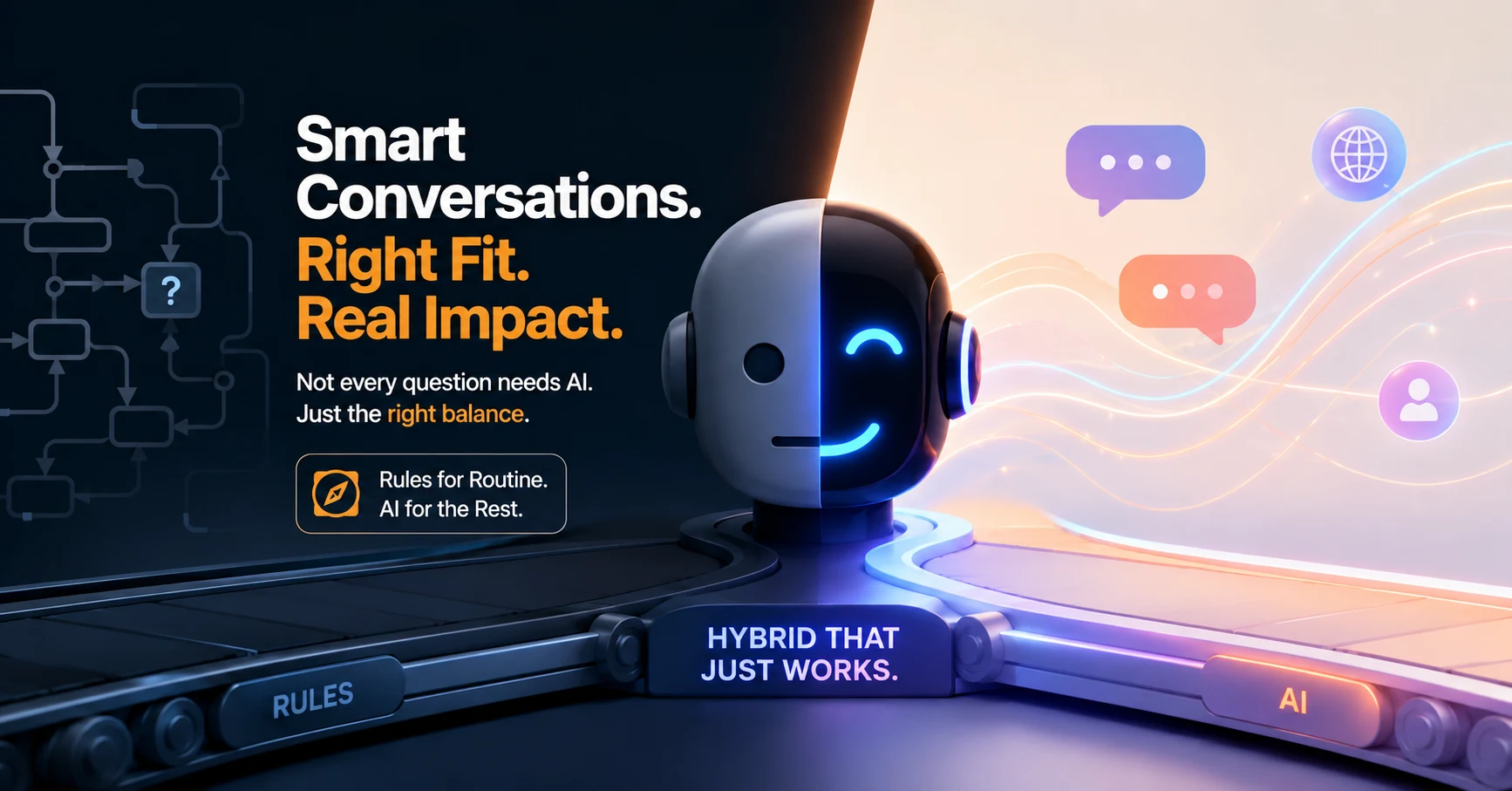
The remaining 30% reach a human with context. Better conversations, Happier Customer.
Most businesses don't choose the wrong chatbot. They choose the right chatbot for a problem they don't actually have. A mid-size retailer spent six months and a painful budget building a sophisticated AI assistant to answer "what are your store hours?" and "where's my order?" A rule-based bot would have done that on day one, for a tenth of the cost.
The counterexample exists too: a SaaS company bolted a rigid decision-tree bot onto a product where every customer query is different, then wondered why their support tickets never dropped. The real question isn't which technology is better. It's which one fits the shape of the conversations your customers are actually having.
Before picking a side in the AI-versus-rules debate: Which one fits the shape of the conversations your customers are actually having?
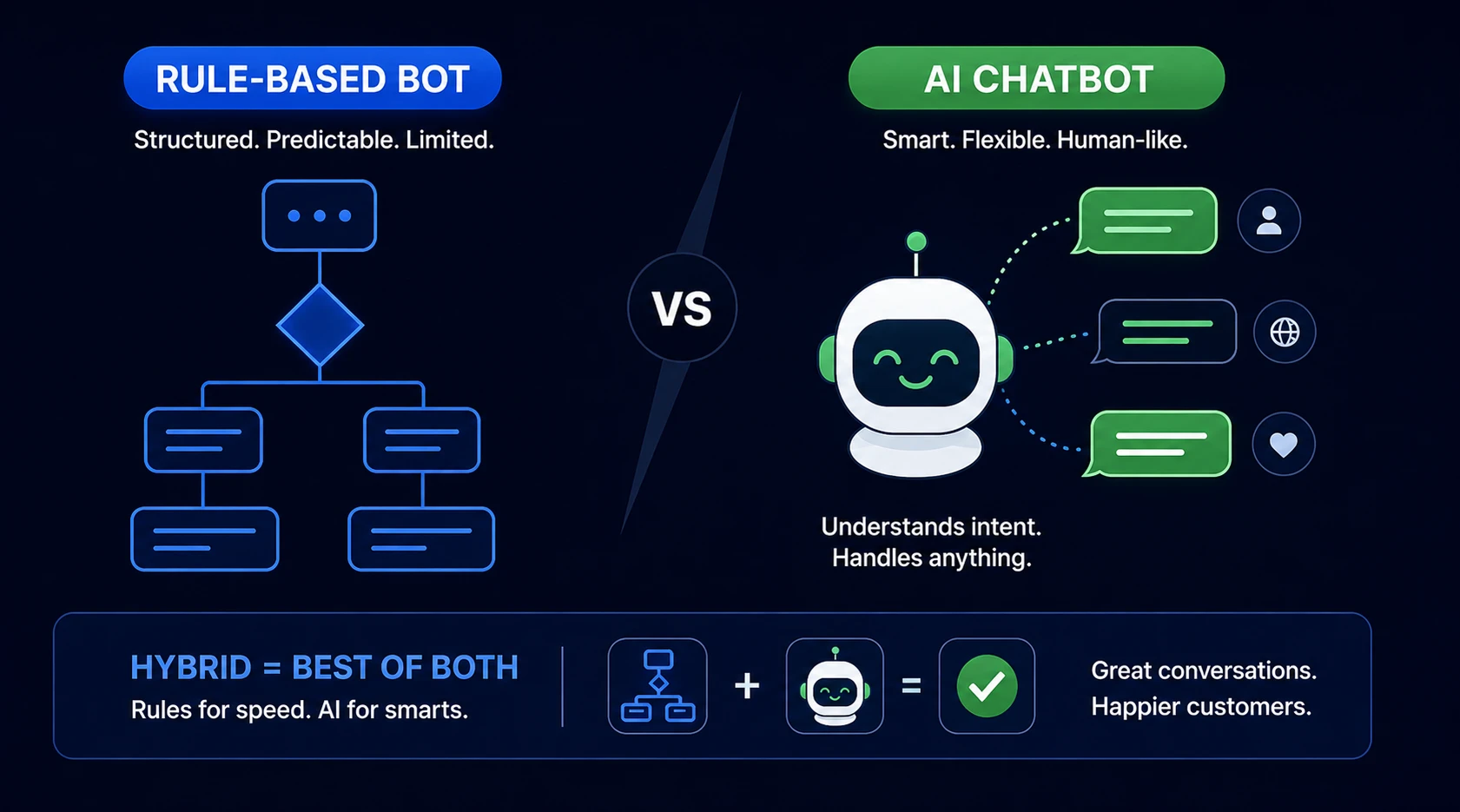
Follows a script. You map the paths in advance — if the user clicks this, show that; if they type "refund," trigger the refund flow. Predictable, cheap, and completely blind to anything you didn't anticipate.
Understands intent. Built on large language models and NLP, it can interpret a messy, half-spelled, emotionally charged question and respond like it actually read what you wrote. It learns. It handles the queries nobody scripted.
| What you're weighing | Rule-based bot | AI-powered chatbot |
|---|---|---|
| Handles unexpected questions | No | Yes |
| Setup cost | Low | Moderate to high |
| Time to launch | Days | Weeks |
| Ongoing maintenance | High as rules grow | Lower, learns over time |
| Brand / compliance control | Total | Needs guardrails |
| Language flexibility | Limited | Strong, multilingual |
| Best for | Narrow, repetitive tasks | Varied, complex chats |
There's a quiet snobbery in tech about rule-based bots, as if they're a relic. They're not. For a large set of problems, they're the smarter choice. When interactions are narrow and repetitive — booking a slot, checking a balance, routing a call, qualifying a lead with five fixed questions — rules are faster to deploy, cheaper to run, and easier to control.
The moment a customer steps off the script, the bot falls apart. It can't improvise. And padding out every branch of a decision tree gets unwieldy fast — a clean flow becomes a tangle of edge cases nobody wants to maintain.
AI bots shine exactly where rule-based ones break: open-ended, varied, unpredictable conversation. Picture a customer who types: "I was charged twice last month but only got one delivery and now the app won't let me log in."
Sees three triggers and panics
Untangles it, reads the frustration, resolves or escalates with full context
Trade-offs to know
AI bots cost more to build and run. They need good data and clear guardrails, or they'll occasionally say something confidently wrong. In India, anything touching customer data has to respect DPDP — so where the model runs and where the data sits is a real decision, not an afterthought.
The most effective deployments are hybrids. A rule-based layer handles the high-volume, predictable stuff instantly — order status, store hours, password resets — while an AI layer takes over the moment a conversation gets nuanced. The customer never sees the seam. They just get a fast answer when the question is simple and an intelligent one when it isn't.
Order status, store hours, FAQ — handled instantly by the rules layer, no wait, no cost
The nuanced, emotional, high-stakes ones — handled by AI or escalated to humans with full context already attached
Skip the feature comparison for a second and answer four questions about your own business.
Mostly the same handful → lean rules. All over the map → lean AI.
High volume of simple questions rewards automation of either kind. Low volume of complex ones may not justify a heavy AI build.
Tight compliance favours the predictability of rules — or AI with deliberate guardrails and data residency.
If your team is drowning in repetitive tickets, the goal is to free them for the conversations that need a person.
If you answered "varied, high volume, somewhat regulated, and yes please free my team" — you're looking at a hybrid, and you're in good company.
This is where the technology choice meets execution — and execution is usually what separates a chatbot that helps from one that quietly annoys everyone. The architecture matters: how intent is detected, how the bot escalates, how it connects to your CRM and order systems, where the data lives.
At Swaran Soft, the work starts with that hybrid logic rather than a tool. The conversational AI builds run on an open-source stack, keep data inside India, support multiple Indian languages, and wire into the channels customers already use — including WhatsApp where the conversation lives there. No vendor lock-in. You can start with a focused rule-based flow and grow into AI as needs evolve, rather than rebuilding from scratch.
Not sure which way your queries actually lean? Swaran Soft's AI strategy team runs a free assessment against your real query data — we show you the rule-vs-AI-vs-hybrid split before you spend a rupee building anything.

AI Architect and Entrepreneur building India's Edge AI ecosystem. 25+ years in enterprise technology. Founder of Swaran Soft, Gignaati, and Copilots.in.
Rule vs AI vs Hybrid — the one-page framework with question scripts to run against any vendor or internal use case.
Talk to a Chatbot Architect
Free 30-min assessment. See the rule-vs-AI-vs-hybrid split for your own query data.
Book Free Assessment