How a fast-growing D2C brand automated 1,200+ weekly WhatsApp orders — cutting the order cycle by 60%, eliminating manual data entry, and freeing the sales team to sell instead of type.
Picture a typical fast-growing D2C brand: 200 active distributors, 800 retail buyers, and a sales WhatsApp group that generates over 1,200 messages a week. On paper, demand is strong. In reality, the sales team is drowning.
Every order arrives as a free-text WhatsApp message. Someone reads it, checks stock by calling the warehouse, re-keys the order into the ERP, types the invoice details back into WhatsApp, and waits for payment confirmation. The cycle takes hours — and it breaks the same way every time: wrong SKU, wrong quantity, wrong price tier, wrong distributor code, or simply a message buried under thirty others.
The hidden tax is not the time spent on any single order. It is the compounding cost of manual transcription at scale — the orders that ship wrong, the buyers who chase for updates, the sales reps who spend 60% of their day doing data entry instead of selling. That is the problem an agentic WhatsApp B2B commerce bot is built to remove entirely.
Every platform tried to become the B2B buyer's preferred ordering channel. WhatsApp won without trying. Distributors in Tier-2 cities, kirana store owners, and regional sales managers all have one thing in common: WhatsApp is already open, already trusted, and already the place where business gets done. The right automation strategy meets buyers exactly where they are.
Buyers order exactly as they already text — product name, quantity, delivery address — no new app, no new login.
No portal adoption challenge. WhatsApp is already on 500 million Indian phones. The buyer just sends a message.
From the flagship distributor in Mumbai to the field agent in a Tier-3 town — same bot, same experience.
Seven capabilities, end to end — from the buyer's first WhatsApp message to the delivered parcel. Each one removes a manual hand-off from your current process.
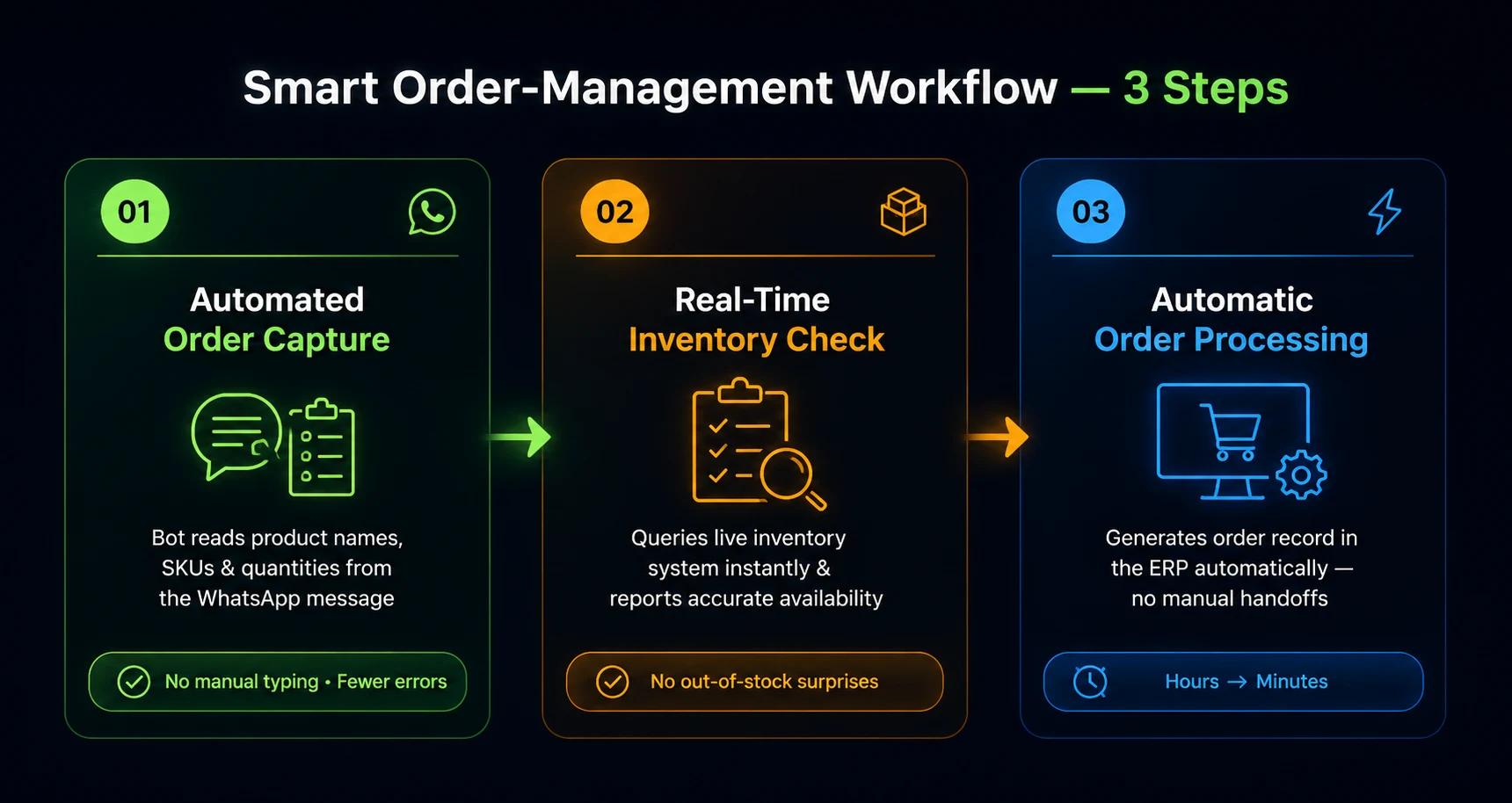
Parses natural-language product requests in any format — SKUs, product names, quantities — from a buyer's WhatsApp message
No structured form required; buyers order exactly as they speak
Calls the live inventory API in real time to confirm stock availability before confirming the order
Zero overselling; buyer knows immediately if an item is out of stock
Applies the correct tier price, distributor discount, or promotional rate for that specific buyer account
Pricing errors eliminated; each account gets its contracted rate automatically
Writes the confirmed purchase order directly into your ERP or OMS — no copy-paste, no spreadsheet
Order enters fulfilment immediately; no inter-team delay
Generates and delivers the correct invoice, payment link, or bank-transfer reference to the buyer on WhatsApp
Payment cycle shortens; buyer receives instructions before they leave the chat
Proactively notifies the buyer at each logistics milestone — dispatch, in-transit, out-for-delivery, delivered
Inbound tracking queries drop by up to 80%; buyer experience improves
Routes genuinely complex situations (partial stock, credit holds, custom pricing requests) to a human sales rep with full conversation context
Sales team only handles what requires human judgement — not routine data entry
This was never “just a chatbot.” It is an agentic AI workflow built for an enterprise environment, where reliability, accuracy and clean system integration are non-negotiable. Three steps carry the load.
Many brands have tried WhatsApp chatbots for order management and found them wanting — they capture intent but cannot act on it. The distinction between a chatbot and an agentic AI system is the difference between an assistant that talks and an assistant that does.
Normal chatbot
Asks the buyer to call the sales team to check pricing
Agentic AI
Applies the correct tier price and distributor discount automatically from your pricing engine
Normal chatbot
Sends a generic "I cannot process this" message and stops
Agentic AI
Routes the exception to the right human with full conversation context pre-loaded
Normal chatbot
Collects information in a structured form
Agentic AI
Writes the ERP record, triggers the invoice, dispatches the delivery notification — all as one connected workflow
Measured across D2C and FMCG deployments handling high-volume B2B WhatsApp order flows.
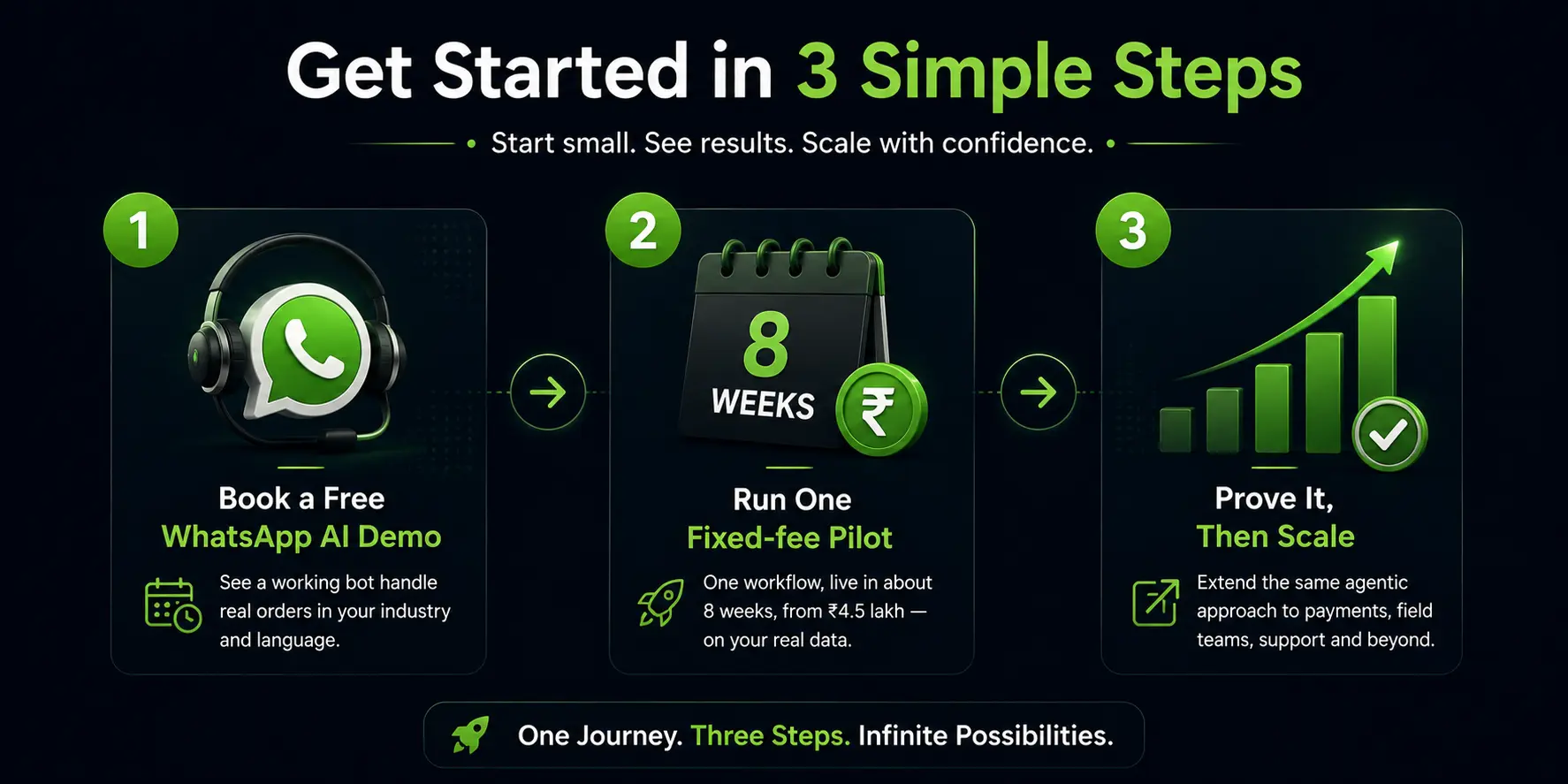
Free live demo — a working WhatsApp B2B commerce bot connected to a sample ERP, processing real orders in real time. Bring your order volume and SKU complexity; we'll show you what the first week looks like.
Yogesh Huja — Managing Director, Swaran Soft | Author, Adopting AI Agents
From January 2026, Meta requires all businesses sending more than a threshold of templated messages on WhatsApp Business API to work through a registered Business Solution Provider (BSP). Brands that built direct API integrations through unofficial routes, or that rely on un-approved bulk-messaging tools, will face account restrictions or suspension.
The Swaran Soft WhatsApp B2B Commerce Bot is built entirely on the official Meta Business API through a compliant BSP pathway. Every message template is approved. Every conversation flow follows Meta's commerce policy. The January 2026 policy change is not a risk — it is a forcing function that makes unofficial tools unviable and gives compliant deployments a structural advantage.
If your current WhatsApp order management relies on unofficial tools or group chats, this is the right time to migrate to a compliant agentic layer.
ROI calculator, ERP integration checklist, and 8-week deployment roadmap — everything you need to pitch and build a production order bot.
Speak directly with Swaran Soft

AI Architect and Entrepreneur building India's Edge AI ecosystem. 25+ years in enterprise technology. Founder of Swaran Soft, Gignaati, and Copilots.in.