
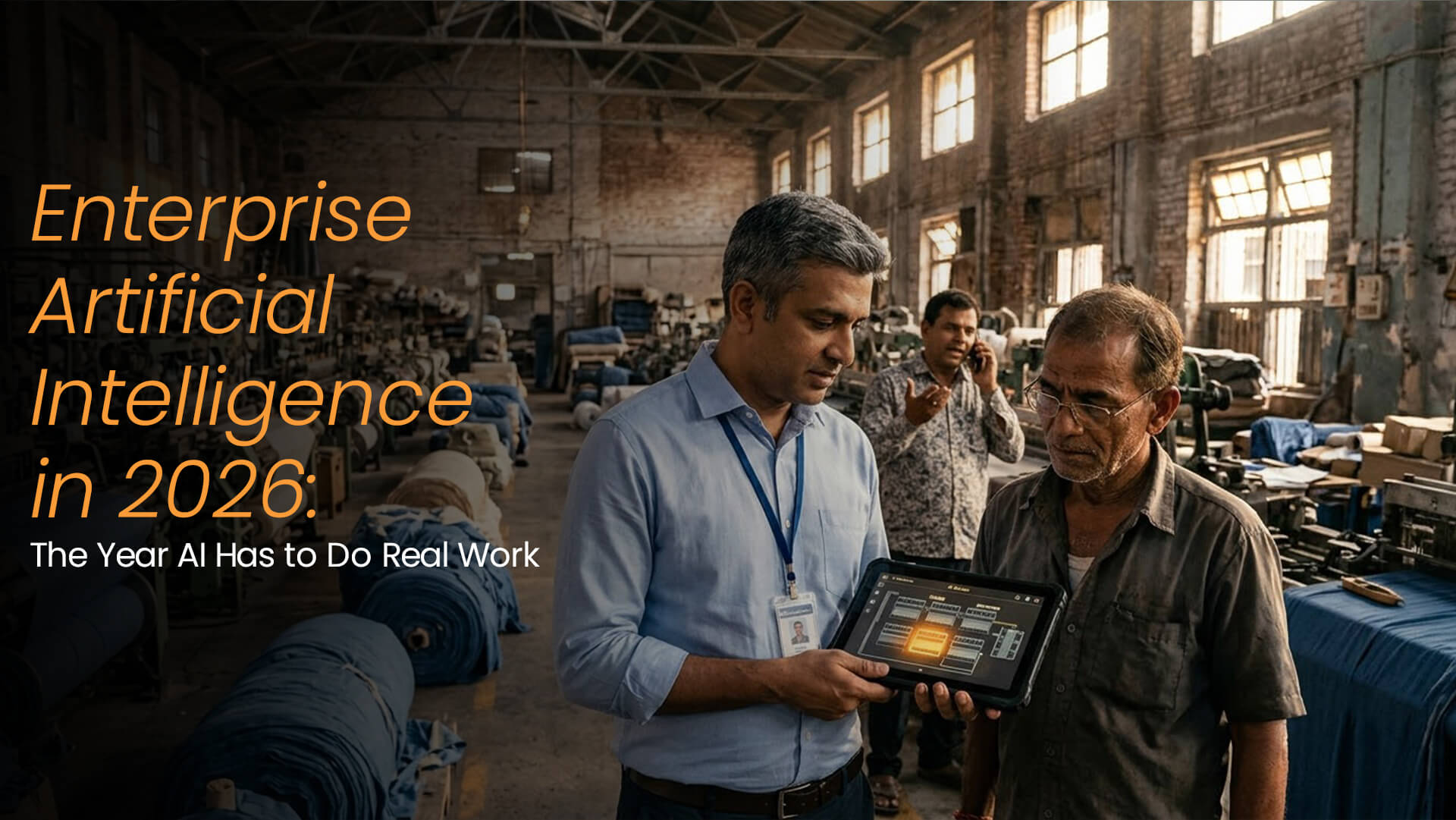
Back in 2024, at the tea counter outside the boardroom, Vikram's chairman turned to him and said, “So what are we doing about this AI thing?” Vikram is the CIO of a textile group in Surat, so he did what most CIOs did back then. He ran a chatbot pilot, showed it at the next board meeting, and everyone clapped. This year the chairman stopped him again. The question was different. “Why isn't it doing any actual work yet?”
That shift, from “should we try AI” to “where's the work it was supposed to do”, sums up enterprise artificial intelligence in 2026 pretty well. I'll get to what's changed in a minute. After that, where it's already paying for itself, how I'd plan the year if I were in Vikram's chair, a few mistakes I'd bet money on seeing, and how to tell if any of it's working.
Nobody's impressed by a website chatbot anymore, are they? The stuff that matters is less visible. A purchase order arrives by email at 6:40 pm. Before anyone's even seen it, the AI has opened the attachment, checked the rates against the contract and put it into the ERP. A person only hears about it if something doesn't match.
Three things made that possible. Agents can now carry a task across several systems instead of just answering a question about it. Indian languages have got good enough that a dealer in Rajkot can send a voice note in Gujarati and get a sensible reply. And the cost of getting started has dropped a lot, mostly because open-source models mean you aren't forced into one expensive foreign platform.
There's a fourth thing, and it isn't technical. The main duties under the DPDP Act start on 13 May 2027, and they apply to any AI that touches personal data. Building privacy in this year is far cheaper than bolting it on next year, once a dozen tools are already running.
Picture what that looks like at Vikram's company. A dealer from Rajkot sends a WhatsApp voice note at 9 pm, in Gujarati, asking for forty bales of the blue cotton. By morning the agent has worked out what he wants, seen that there's stock and that his credit's fine, and has a dispatch note waiting. Someone in Vikram's team glances at it and approves. Nobody retypes anything, and the chairman finally has his answer.
Where does it pay first? Finance, usually. The accounts team at Vikram's company used to spend the last week of every month matching invoices to purchase orders by hand and sending awkward reminder emails to dealers who were late paying. That's precisely the kind of work AI eats for breakfast. HR isn't far behind, mostly with helpdesks that answer the same leave and payroll questions all day long.
Operations is where it gets interesting. Maintenance, mainly. Vikram's maintenance head, who's been fixing looms since before most of his team were born, was openly sceptical. Then the system flagged a motor on loom 14 two days before it seized. He fixed it on the Sunday, and he's been a lot quieter about AI since. The inspection forms changed too. People fill them in standing at the machine now, not at the end of the day from memory. And the sales and service people? They mostly just like that they can reply faster, in whatever language the customer wrote in.
Compliance is the quiet winner. A person checks a sample of transactions because there's no time to check them all. The AI doesn't get bored, so it goes through every last one, and it writes down what it checked. Audit week becomes a lot less tense.
Here's the part that surprised Vikram most. Getting the first project talking to the ERP was hard work, weeks of it. The second one reuses that connection, and the third reuses it again. By the fourth use case, you're mostly paying for the new idea, not the plumbing.
Leave the tech out of the first conversation. In Vikram's case, the chairman's pet complaint was collections, money sitting with dealers for months. The head of service had his own: too many repeat calls. Dispatch dates slipping was a third. Pick three of those. Any AI idea that doesn't help with at least one of them can wait.
Then put a number on each one, something you can check later, like days to collect a payment or hours spent per hundred orders. Without a number, you'll never be able to prove the project worked, and the chairman's next question will be harder than the last one.
I've watched companies spend a year cleaning every database before starting any AI work. They never finish. Get the data for your first use case into shape, connected and reachable, and leave the rest for later.
Spend the first week checking it properly. Is it complete? Is it current? Can the system actually get at it? Finding a gap in week one costs you a shrug. Finding it in week seven costs you the project.
Then pick one, just one, and give it about eight weeks, a budget nobody's allowed to stretch, and a goal you could write on a Post-it. My test for when it's done is blunt. Are real people using it every day, without being chased? If not, it isn't done. A demo that impressed the steering committee doesn't count.
Put a business owner's name on it too, someone whose own targets depend on it working. Pilots without an owner tend to drift until everyone forgets about them.
If your staff live in WhatsApp, email and the ERP, that's where the AI should show up. Vikram tried a separate portal once. Usage peaked in week one and was close to zero by week four. Wire it in through proper APIs. The screen-scraping shortcut looks tempting and cheap, right up until the morning a vendor updates its software and your clever little bot stops working without warning.
Three questions to settle early, ideally on day one. Where's the data going to live, who's allowed to look at it, and how will you know later why the AI did what it did? With the DPDP duties arriving in May 2027, this isn't optional any more. Keeping sensitive data inside India, ideally on your own infrastructure, makes the legal team's life a great deal easier.
It also helps to set up a little review group. Vikram's has four people in it, one each from IT, legal, risk and the business, and they meet on the first Monday of the month for about an hour. They okay new use cases and go over anything that misfired. Anything more formal than that and good ideas start queueing.
When the first one goes live, sit someone down that very week and make them write the whole thing up, step by step, warts included. Memories fade fast. The second, third and fourth projects then borrow from it shamelessly, the same set-up, the same review process, even the same training slides. It honestly does get quicker and cheaper each time. Put two people from your own side in charge of that write-up. Consultants leave. The recipe shouldn't.
If AI belongs to everybody, it belongs to nobody. The companies that are moving fastest give each use case to a business owner whose own numbers ride on it. Vikram doesn't own the dealer-order agent. The head of sales does, and he cares a great deal about whether it works.
IT's role doesn't vanish. Somebody still has to keep the lights on, keep the bad guys out, and make sure the ERP and the AI are actually talking. Then you want a tiny central team, three or four people, nothing grand, whose main job is to stop every department buying its own version of the same tool. Vikram's rule of thumb is that if the central team needs its own meeting room, it's grown too big.
Here's the rough plan for Vikram's year. Yours will differ, and that's fine, push the months around to suit.
| Phase | Timing | What happens | Output |
|---|---|---|---|
| Discover | Month 1 | Rank use cases, check data, agree targets | Shortlist of three use cases |
| Pilot | Months 2 to 3 | Build and test with real users | One use case live in production |
| Integrate | Months 4 to 5 | Connect fully to ERP, CRM and HR systems | No manual steps left |
| Scale | Months 6 to 9 | Reuse the playbook for new use cases | Several live use cases |
| Optimise | Months 10 to 12 | Tune, retrain staff, review results | Rising value per use case |
Chasing every new model release is going to waste a lot of money in 2026. It goes like this. A shiny new model launches, the chairman reads about it on a Sunday, and by Monday afternoon the team is being asked to rip out something that was working perfectly well. The fix is to build on a stack where models can be swapped in and out, and then mostly ignore the news.
The scary one is letting agents loose too early. Imagine an agent with the power to release payments in its first week. I'd rather not. Let it suggest at first. Then let it act, but only after someone approves. Only once it's built up a track record should it get more freedom.
Lots of companies still run far too many pilots in parallel. Ten pilots that are half done will lose to two that are live every single time. Get one over the line, show it works, and only then start the next.
And then the people. Staff who suspect the AI is after their job won't touch it. Same for staff who were never shown how. Vikram learnt this one the hard way, and the second time round he took the training to the factory floor itself, in Gujarati and Hindi, with chai. There was a WhatsApp group for questions afterwards too. It got used, a lot, which is the whole point.
Get the “before” picture down on paper before the pilot even starts. How long does a task take? Note the cost of each transaction too, how often things go wrong, and how many hours a customer sits waiting for a reply. Don't round anything in your favour. Those slightly embarrassing numbers are the ones you'll be glad you kept.
Once it's live, Vikram asks three questions at every monthly review. Are we saving hours or rupees? Are errors going down and compliance going up? And are people actually using it, week after week? People forget the third question surprisingly often.
Costs go in too, all of them. Licences, cloud bills, the integration work, support, and the hours people spent in training. Vikram puts the lot on one sheet of paper for the board each month. Small, honest numbers have done more for his credibility than any big promise ever did.
A word about us. Swaran Soft has been building enterprise systems for over 25 years now, for more than 350 clients around the world. Most of the time we kick off with an AI strategy and roadmap, which is basically a ranked list of what's worth doing and what's doable. One client's board looked at that roadmap and signed off a ₹2 crore AI investment on the strength of it.
From there, our 8-week fixed-fee pilot takes the first use case from contract to production, on an open-source stack so you're never locked in. Our HR AI agent is a good example of what that looks like. It cut query resolution from 2 days to under 4 minutes, with around 70% of questions answered automatically on WhatsApp, and our agents work in 9+ Indian languages.
So, 2026. The playing-around stage is done. AI has to pull its weight now, and the boards know it. Start from something your directors already moan about. Don't clean data you don't need yet. Push one pilot all the way to real use, inside the apps people already have open, and get your privacy house in order before May 2027 comes round.
Then copy what worked, again and again. Every use case gets an owner. The numbers stay honest. Your people stay in the loop. And the next time the chairman wanders over at the tea counter, you won't need to change the subject.
Want to talk it through with us? We run a free 45-minute AI Pilot Assessment. Drop a line to info@swaransoft.com, or ring +91 9220-313-650 (India) | +971-50-9292-650 (UAE). You'll find more at www.swaransoft.com

AI Architect and Entrepreneur building India's Edge AI ecosystem. 25+ years in enterprise technology. Founder of Swaran Soft, Gignaati, and Copilots.in.