Choose the wrong enterprise AI company and it can cost a lot to fix later — usually you notice only after the deal is locked in. Here are seven questions to ask. Ten minutes to go through them, and the answers will be more useful than any pitch deck.
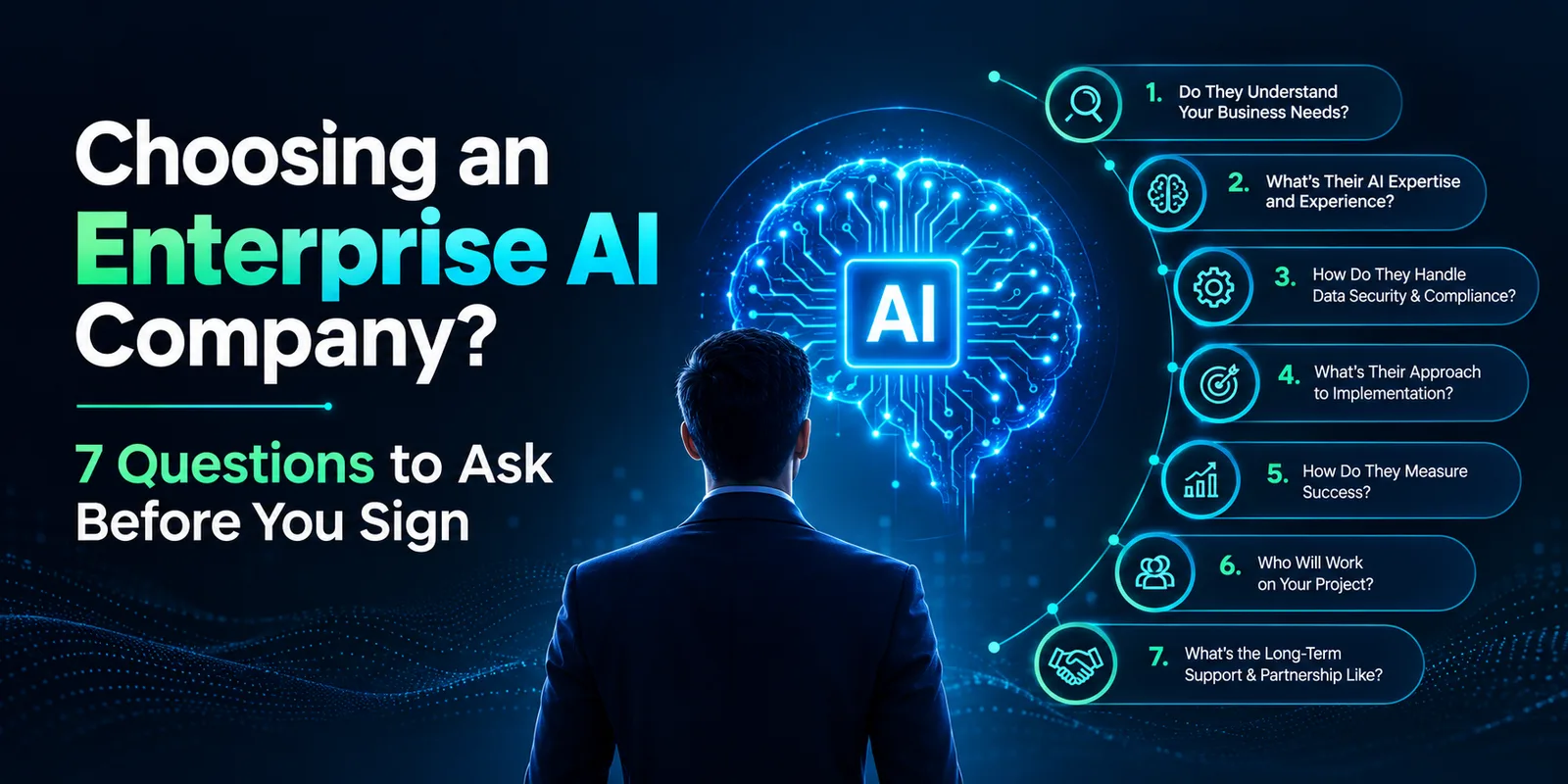
Picking the right enterprise AI company can feel tricky. It's not like grabbing a new software tool and switching again next quarter. Once the work starts, your data ends up in their systems. Over time, your team changes the way it does things, because the new setup becomes the daily routine. Unwinding all of that is slow and costly — so the leverage is almost entirely up front, before you sign.
The problem? Everyone sounds good in the pitch. The deck is polished, the demo runs smoothly, the confidence is total. None of that tells you whether they've taken a system live on messy real-world data, or what happens to your data once it leaves the room, or whether you'll still control any of it a year from now.
The seven questions below are designed to get underneath the pitch. None of them is a gotcha. A strong partner answers all seven easily and probably appreciates that you asked. A weak one gets vague. And that vagueness is the signal you came for.
Ask them in order. Each one filters out a different kind of weak partner.
Anyone can show you a demo that works on clean sample data. Far fewer have taken an AI system live on real data, kept it running, and watched it survive a security review. Ask for a system you can see and a client you can call. An enterprise AI company with a production track record answers this in seconds. One without it changes the subject.
This is the fastest way to separate real AI capability from a wrapper over someone else's cloud. Ask them to trace the path your data takes, step by step. If it leaves your environment for a foreign API, you have a DPDP problem and a cost problem. A strong partner offers on-premise or India-hosted deployment and can explain it clearly.
You're paying for it, so you should own it. Get a plain answer on whether the models, the code, and the documentation are yours to keep. If the honest answer is that everything lives inside their proprietary platform, you're renting a capability you'll never control — and the price of leaving only goes up over time.
An AI model gets less accurate as the world changes around it. This is normal. It's also the question that exposes pretenders. A partner who has run AI in production will talk naturally about monitoring and retraining. One who thinks a model is 'done' at launch has never watched one quietly degrade in the wild.
The best engagements leave you stronger, not more dependent. Ask what your own people will be able to do after go-live, and what documentation and training you get. If the answer is that you'll always need to call them for changes, that dependency is the product they're really selling.
'All-inclusive' can feel neat, but it can also hide extras. Request a simple breakdown: how much is the build cost as a fixed amount, and what part grows after go-live and depends on use? A partner who can show you a fixed pilot cost and honest running numbers is one you can budget around.
Ask this early, and watch the reaction. A confident partner has a clean answer: here's what you take with you, here's the timeline, no drama. An evasive one reveals that leaving is meant to be painful. You're pressure-testing whether this is a partnership or a trap.
The left column is the comfortable line you'll hear. The right is the evidence a serious enterprise AI company puts behind it.
| What a Weak Partner Says | What a Strong Partner Shows |
|---|---|
| “We can do anything with AI” | Here are the two or three use cases worth doing first, and the ones we'd talk you out of |
| “It all runs in the cloud, don't worry” | The data flow on a simple diagram — and an on-premise option if your rules are strict |
| “We use the biggest, latest model” | A model chosen to fit your task, privacy needs, and budget — not the loudest label |
| “You won't have to touch it” | Runbooks, clear docs, and training so your team can run and update it |
| “We'll support it, don't worry” | An SLA in writing, plus a plan for the day you decide to bring it in-house |
| “Trust us, it works” | References, a live system to see, and a scoped paid pilot before the big commitment |
| “The price is all-inclusive” | A clean split of fixed build cost versus any variable running cost at real volume |
| “Lock-in? That's not a thing with us” | Open, model-agnostic components and a written exit clause you can actually use |
Three of the seven questions come down to the same thing: control. Where your data lives, who owns what you build, and whether you can walk away. Get these three right and most other risks shrink.
On-premise or India-hosted deployment keeps sensitive data inside your walls. The clean path to DPDP Act compliance and sector rules.
Models, code, and documentation handed over on an open, model-agnostic stack. No proprietary black box you can't change.
A written exit clause and a portable system. You can bring it in-house or move it without a rebuild, if it ever comes to that.
We wrote these questions the way we'd want a client to interrogate us. Swaran Soft deploys on-premise through Copilots.in, hands over the models and code, and puts the exit terms in writing — across our AI strategy and consulting and Agentic AI development work. If a partner flinches at any of the seven, that's useful information. Use it.
The same seven criteria, applied across the kinds of partner enterprises usually shortlist.
| Criterion | Enterprise AI Company | Offshore Dev Shop | Big Consultancy | Freelancer |
|---|---|---|---|---|
| Production track record | Live enterprise deployments | Varies by project | Strategy-heavy, less build | Individual, unproven at scale |
| Data stays in India / on-prem | Yes, India-hosted option | Often on foreign cloud | Advises, doesn't host | Depends on their tools |
| You own models & code | Yes, handed over | Sometimes | Rarely, leaves with them | Usually yes, if scoped |
| Model lifecycle support | Monitoring & retraining | Rarely in scope | Separate engagement | Unlikely |
| Capability transfer | Built into delivery | Limited | Limited | Minimal |
| Price transparency | Fixed pilot + clear running cost | Low headline, hidden extras | High, recurring | Cheap until it isn't |
| Clean exit, no lock-in | Written exit, open stack | Varies | N/A, advisory | Usually clean |
Score every shortlisted partner against these. The closer they get to all six, the safer the signature.
Pain: Every vendor sounds confident and the pitches blur together. Hard to tell real capability from a polished sales deck.
Outcome: A short, sharp checklist that cuts through the pitch and surfaces the partner who can actually deliver and hand over.
Pain: Worried about being handed a black box built on a proprietary stack that only the vendor understands.
Outcome: The right technical questions to ask (data flow, ownership, model lifecycle) and clear signals of who passes them.
Pain: Fear of an open-ended cost, weak SLAs, and an exit clause that turns out to be a trap when it's needed.
Outcome: Clarity on fixed versus variable cost, the terms that matter most, and a paid pilot that de-risks the big decision.
"We wrote the questions we'd want to be asked. If a partner gets uncomfortable when you ask where your data goes or what happens when you leave, you've learned the most important thing about them before signing a thing."
A printable scorecard to score every shortlisted AI partner against these seven questions — and a free 20-minute review of your shortlist.
Send us your shortlist and we'll score it against the 7 questions with you.

AI Architect and Entrepreneur building India's Edge AI ecosystem. 25+ years in enterprise technology. Founder of Swaran Soft, Gignaati, and Copilots.in.